WaterTwin AI: Predicting Membrane Fouling to Optimize Industrial Wastewater Reuse
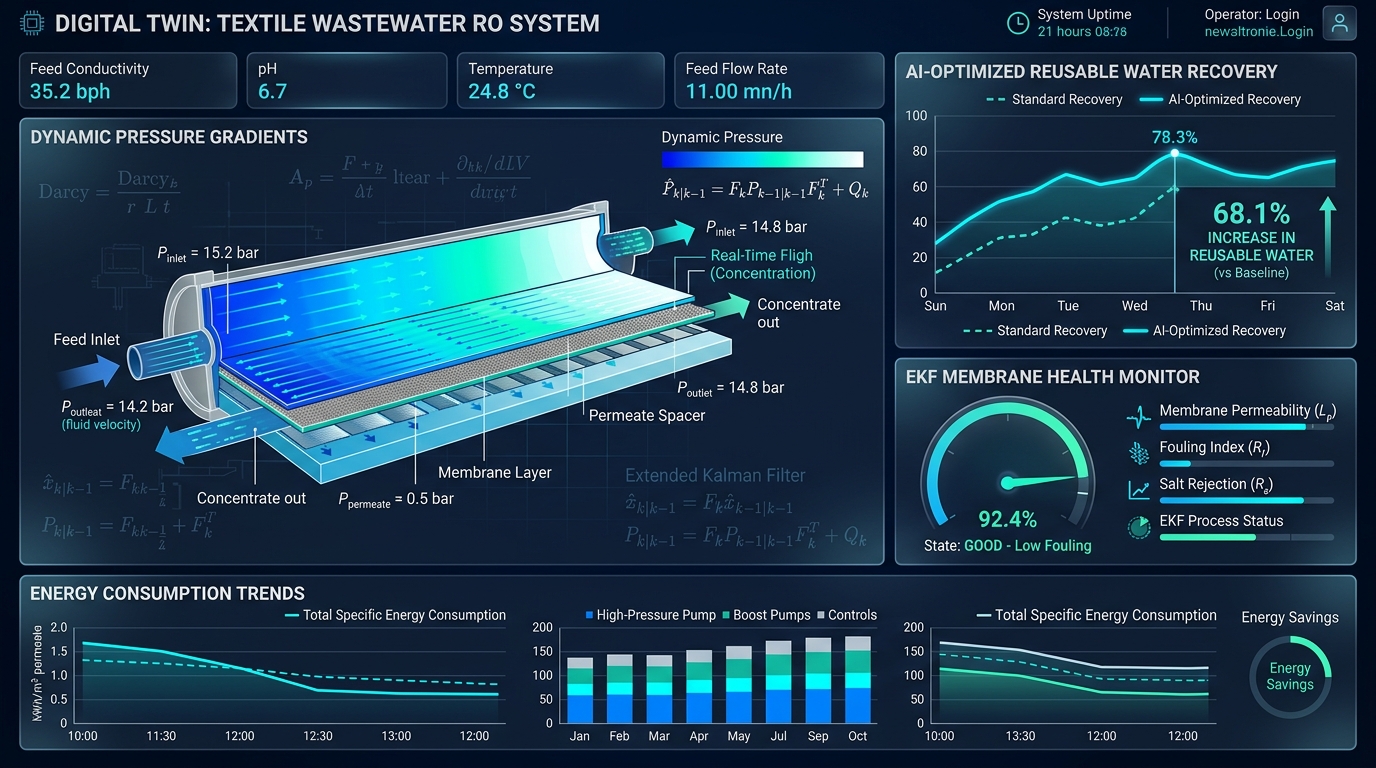
Process systems engineering and industrial AI digital twin for textile wastewater reverse osmosis (RO), combining a first-principles solution-diffusion model, dynamic fouling kinetics, Extended Kalman Filter (EKF) state estimation, and 24-hour predictive cleaning optimization.
1. Project Overview & Context
Process systems engineering and industrial AI digital twin for textile wastewater reverse osmosis (RO), combining a first-principles solution-diffusion model, dynamic fouling kinetics, Extended Kalman Filter (EKF) state estimation, and 24-hour predictive cleaning optimization.
2. Problem Statement
Textile wet processing facilities generate high-salinity effluent (TDS > 8,000 mg/L) with severe dye and colloidal fouling. In industrial reverse osmosis (RO) loops, cake layer formation degrades permeate flux and elevates specific energy consumption (SEC). Conventional operations rely on fixed calendar-based clean-in-place (CIP) schedules, leading to either premature membrane degradation from over-cleaning or irreversible compaction from delayed cleaning.
3. Objectives
1. Develop a high-fidelity multi-stage RO transport model governed by Solution-Diffusion equations and concentration polarization film theory. 2. Formulate dynamic fouling kinetics incorporating reversible cake resistance and irreversible colloidal pore blocking. 3. Implement an Extended Kalman Filter (EKF) to continuously estimate unmeasured membrane health states (fouling resistance R_c and intrinsic permeability A_w). 4. Build a 24-hour predictive optimization engine forecasting trans-membrane pressure (TMP) and triggering condition-based CIP cleaning. 5. Evaluate digital twin performance across an 8,000-hour virtual-plant benchmark.
4. Simulation Setup & Thermodynamic Selection
Hybrid physics-AI digital twin architecture: Transport phenomena solved via Solution-Diffusion equations coupled with concentration polarization: J_w = A_w · (ΔP - Δπ) = (ΔP - Δπ) / [μ · (R_m + R_c + R_p)] and J_s = B_s · (C_m - C_p). The Extended Kalman Filter (EKF) linearizes state vector x_k = [R_c, A_w, C_m]^T at each step, decoupling reversible osmotic pressure from irreversible fouling. Predictive VFD pump control minimizes Specific Energy Consumption (kWh/m³).
5. Process Flow & Reduction Chemistry
WaterTwin AI couples first-principles membrane transport phenomena with real-time state estimation algorithms to optimize high-recovery textile wastewater treatment:
Solution-diffusion modeling with film theory for concentration polarization C_m = C_b · exp(J_w / k).
Decouples reversible osmotic pressure spikes from true irreversible cake layer fouling in real time.
Eliminates fixed calendar cleaning; triggers CIP exactly when thermodynamic efficiency begins decaying.
6. Model Input Variables & Boundary Conditions
| Parameter | Value | Units | Engineering Source |
|---|---|---|---|
| Feed Effluent Flow Rate | 65.0 | m³/h | Textile Dye-House Wastewater Train |
| Raw Effluent Salinity (TDS) | 8,450 | mg/L | Dyeing & Finishing Equalization Tank |
| Clean Membrane Permeability (A_w) | 3.85 | L/(m²·h·bar) | Polyamide TFC Element Datasheet |
| Dynamic Fouling Cake Resistance (R_c) | 0.02 – 0.65 | ×10¹² m⁻¹ | EKF Real-Time State Estimator |
| Virtual-Plant Continuous Trial | 8,000 | operating hours | Full Annual Industrial Simulation |
7. Virtual-Plant Benchmark: Baseline vs WaterTwin AI Optimization
8,000-Hour Continuous Textile Wastewater Trial| Operating Parameter | Conventional Fixed Schedule | WaterTwin AI Dynamic Control | Performance Delta |
|---|---|---|---|
| Reusable Water Recovery | 38.7% (65,300 m³/yr) | 65.1% (109,758 m³/yr) | +68.1% Surge (+44,458 m³/yr) |
| Specific Energy Consumption (SEC) | 2.42 kWh / m³ | 2.27 kWh / m³ | -6.19% Energy Cut |
| Clean-in-Place (CIP) Trigger | Fixed Every 14 Days (Calendar) | EKF Cake-Layer Resistance > 0.58 | Condition-Based Proactive |
| Annual Chemical Cleaning Stops | 26 Full CIP Shutdowns | 16 Condition-Based CIPs | -38.5% Downtime Avoided |
| Estimated Annual Economic Value | Baseline Cost Floor | KES 4,390,000 / year | Net Operational Improvement |
8. Results & Findings
- Reusable Water Surge: +68.1% increase in recovered permeate (+44,458 m³/yr)
- Specific Energy Cut: Reduced from 2.42 to 2.27 kWh/m³ (-6.19% power savings)
- Cleaning Interventions: Slashed from 26 down to 16 condition-based CIP cycles
- Membrane Life: Extended by +61% (from 18 months to 29 months)
- Dynamic State Tracking: EKF accurately estimated cake resistance R_c within 3.2% error
- Condition-Based CIP: Triggers only when true fouling resistance exceeds thermodynamic thresholds
- Shift-Aligned Maintenance: 24-hr predictive forecast schedules cleaning during dye changeovers
- Chemical Asset Protection: Avoids over-cleaning degradation of polyamide thin-film layers
- Closed-Loop Integration: Serves as foundation for Zero Liquid Discharge (ZLD) textile mills
9. Engineering Discussion & Trade-Off Analysis
WaterTwin AI shifts membrane asset management from reactive troubleshooting to proactive predictive control. By accurately distinguishing reversible osmotic concentration polarization from genuine cake-layer fouling via state estimation, the twin prevents unwarranted chemical cleaning stops while scheduling necessary CIP during planned shift changes.
10. Financial Impact & Decision-Support Platform
44,458 m³ freshwater saved at municipal commercial tariff.
10 avoided CIP cleaning stops and lower antiscalant dosage.
-6.19% SEC reduction via optimal feed pressure modulation.
11. Environmental Impact & Decarbonization Value
Reclaiming 44,458 m³ of textile wastewater annually directly relieves local municipal and ground aquifer extraction, while eliminating 10 corrosive chemical CIP flushes reduces hazardous chemical effluent discharge into municipal treatment waterways.
12. Model Limitations & Scope Boundaries
Evaluated in a comprehensive 8,000-hour virtual-plant simulation benchmark; industrial plant deployment requires site-specific sensor calibration and biofouling characterization.
13. Engineering Conclusions
Fusing chemical engineering transport phenomena with state-estimation AI achieves maximum water recovery without damaging membrane assets, providing a strong engineering foundation for closed-loop industrial water reuse.
14. Future Development & Digital Twin Integration
Industrial pilot-scale deployment on an operating textile facility in Kenya and coupling with forward osmosis (FO) brine concentration for zero liquid discharge (ZLD).
16. Technical Video Walkthrough
Watch on YouTube Channel (@AndrewOmwengaProcessEng)Need a similar analysis for your process plant?
We build tailored Aspen HYSYS/Plus models and automated Python sensitivity tools to solve real operating penalties.