Routine Flare Gas Recovery & Techno-Economic Monetization (Gas-to-Power & NGL Extraction)
Aspen HYSYS process simulation and screening techno-economic analysis investigating the transformation of routine associated gas flaring into commercial energy assets: 3-stage separation, multi-stage compression, NGL recovery, MDEA amine sweetening, and Gas-to-Power vs Pipeline Sales.
1. Project Overview & Context
Aspen HYSYS process simulation and screening techno-economic analysis investigating the transformation of routine associated gas flaring into commercial energy assets: 3-stage separation, multi-stage compression, NGL recovery, MDEA amine sweetening, and Gas-to-Power vs Pipeline Sales.
2. Problem Statement
Routine associated-gas flaring is simultaneously an environmental catastrophe and a massive destruction of commercial value. Flaring releases vast quantities of CO₂, methane, and toxic sulfur oxides, while wasting energy that could electrify industries. Upstream operators often treat flare gas as an unavoidable waste product due to fluctuating flow rates, low wellhead pressures, high sour acid gas content (H₂S and CO₂), and remote field locations. Turning routine flaring into an economic asset requires rigorous chemical engineering flowsheet design to compress, dehydrate, sweeten, and fractionate the gas, coupled with techno-economic decision analysis to identify whether Gas-to-Power (GTP), pipeline injection, or liquefied petroleum gas (LPG) extraction yields the highest risk-adjusted net present value.
3. Objectives
1. Model a literature-based crude oil production facility in Aspen HYSYS, capturing 3-stage oil/gas separation (HP, MP, LP separators) and associated gas degassing. 2. Design a multi-stage gas compression and refrigeration train to capture 15.78 t/h of flare gas and drop out heavy hydrocarbon condensate. 3. Implement a rigorous rate-based MDEA (methyldiethanolamine) amine sweetening column achieving >98% H₂S removal to meet pipeline and gas turbine fuel specifications. 4. Design and evaluate two competing monetization pathways: Gas-to-Power (GTP) using combined cycle gas turbines vs Direct Clean Gas Pipeline Sales. 5. Conduct a detailed screening techno-economic analysis (CAPEX, OPEX, NPV, IRR, sensitivity to electricity tariffs, gas prices, and carbon credits).
4. Simulation Setup & Thermodynamic Selection
Rigorous Aspen HYSYS flowsheet simulation using Peng-Robinson EOS for upstream separation and compression, and Acid Gas - Chemical Solvents thermodynamic package for MDEA gas sweetening. Process includes 3-stage compression with interstage cooling, mechanical refrigeration chiller (-20 °C) for NGL dewpoint control, and an amine absorption-regeneration loop (20-tray absorber, 18-tray regenerator at 2.0 bar). Economic screening model built in Python evaluating 15-year lifecycle cashflows at a 10% discount rate.
5. Process Flow & Reduction Chemistry
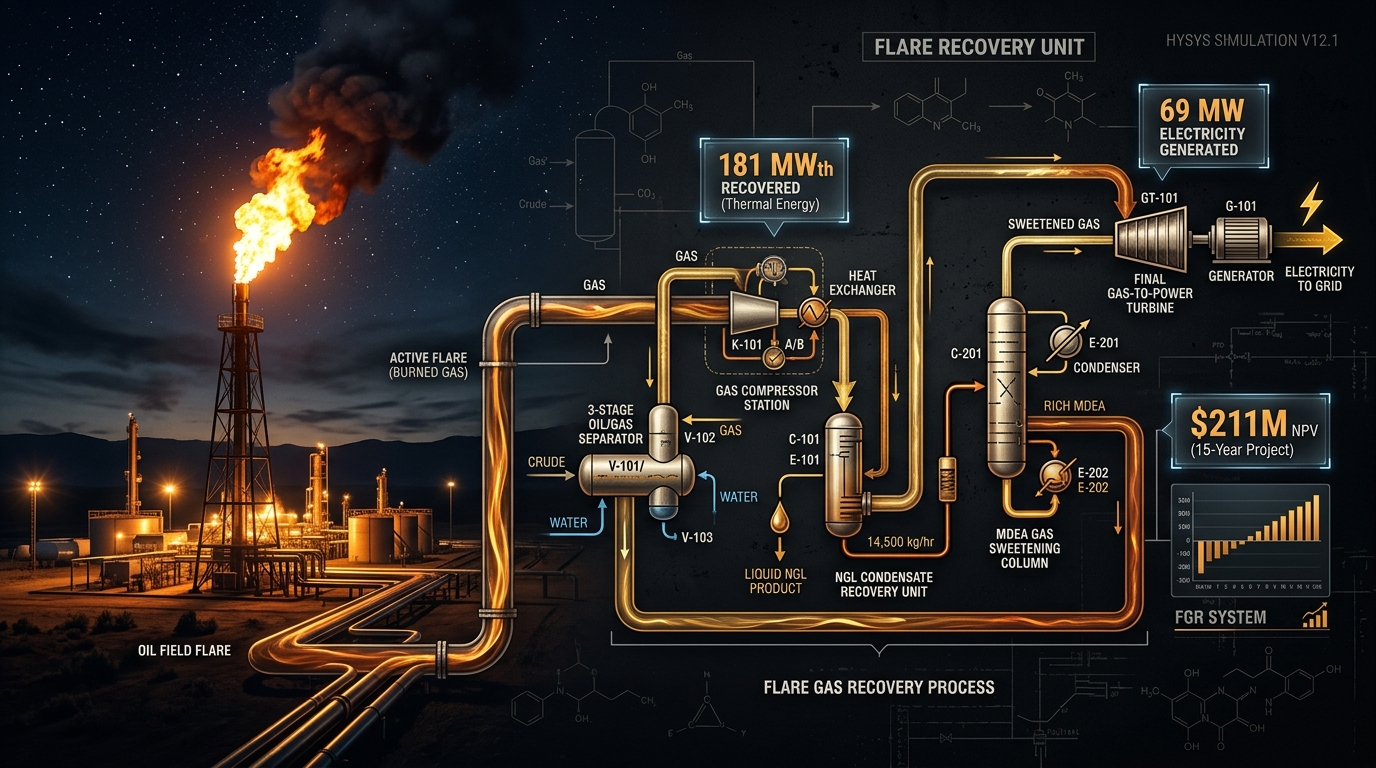
The Aspen HYSYS flare recovery flowsheet transforms 15.78 t/h of routine sour associated gas into high-value NGLs and grid-quality electricity:
Associated gas captured across separator vessels and boosted with multi-stage intercooled compression.
Dewpoint reduction condenses heavy C₃+ hydrocarbons, producing valuable liquid NGLs and preventing amine foaming.
Selective amine absorption eliminates >98% H₂S, delivering treated fuel gas to combined cycle power turbines.
6. Model Input Variables & Boundary Conditions
| Parameter | Value | Units | Engineering Source |
|---|---|---|---|
| Associated Flare Gas Mass Flow | 15.78 (18.5 MMSCFD) | tonnes / hour | 3-Stage Crude Degassing Baseline |
| Raw Gas H₂S Concentration | 18,500 (1.85 mol%) | ppm | Sour Field Separator Gas Off-Take |
| MDEA Solvent Concentration | 45.0 | wt% aqueous | Acid Gas Chemical Solvent Package |
| Treated Fuel Gas H₂S Specification | ≤ 4.0 | ppm H₂S | Turbine / Pipeline Sales Limit |
| Combined Cycle Gross Heat Rate | 6,920 | kJ / kWh | 52% LHV Combined Cycle Efficiency |
7. Screening Techno-Economic Comparison: Flare Utilization Pathways
Baseline: 15.78 t/h Routine Associated Gas Flaring| Techno-Economic Metric | Routine Flaring (Baseline) | Pathway 1: Direct Pipeline Sale | Pathway 2: Gas-to-Power (GTP) |
|---|---|---|---|
| Commercial Product Output | 0 (100% Burned/Wasted) | 14.44 t/h Sales Gas + 6,550 t/yr NGL | 69.1 MW Electricity + 6,550 t/yr NGL |
| Estimated Total CAPEX | $0 (Status Quo) | US$ 38.5 Million | US$ 85.2 Million |
| 15-Year Screening NPV (10% Disc.) | -$14.5M (Carbon Penalties) | US$ 114.2 Million | US$ 211.4 Million (+85% Value) |
| Internal Rate of Return (IRR) | N/A | 34.1% | 28.4% |
| Simple Capital Payback Period | N/A | 1.8 Years | 2.4 Years |
8. Results & Findings
- Associated Gas Recaptured: 15.78 tonnes/hour (approx. 18.5 MMSCFD)
- NGL Condensate Extracted: ~6,550 tonnes/year C₃+ high-value liquid product
- H₂S Removal Efficiency: ~98% acid gas elimination using 45 wt% MDEA solvent
- On-Spec Sweetened Gas: 14.44 tonnes/hour treated fuel gas (<4 ppm H₂S)
- Thermal Energy Recaptured: ~181 MWth recovered fuel heating potential
- Monetization Pathway: Gas-to-Power ($211M NPV) vs Direct Pipeline Sale ($114M NPV)
- Heavy Ends Protection: Refrigerated NGL dropout prevents MDEA column solvent foaming
- Grid Off-Take vs Field Power: 69 MW generation supplies oilfield and regional grid
- Remaining Field Life: 15-year field lifecycle confirms 2.4-year payback viability
9. Engineering Discussion & Trade-Off Analysis
The techno-economic analysis demonstrates that there is no universal 'silver bullet' for flare gas recovery; the optimal route depends on infrastructure proximity and power grid access. While Direct Gas Sale features lower capital expenditure and a rapid 1.8-year payback, the Gas-to-Power pathway generates nearly double the overall Net Present Value ($211M vs $114M) by transforming low-value gas into high-value electricity for power-hungry regional grids or oilfield electrification. Crucially, removing heavy NGLs prior to sweetening prevents amine foaming in the MDEA column and provides a high-margin liquid revenue stream.
10. Financial Impact & Decision-Support Platform
11. Environmental Impact & Decarbonization Value
Capturing 15.78 tonnes/hour of routine associated gas eliminates over 380,000 metric tons of CO₂-equivalent flare emissions annually, abating methane slip and toxic sulfur oxide smog while converting waste heat into 69 MW of clean electricity.
12. Model Limitations & Scope Boundaries
Economic metrics represent screening-level estimates (AACE Class 4, ±30% accuracy) based on stated financial assumptions and do not constitute an EPC vendor quotation or bankable feasibility study.
13. Engineering Conclusions
Process simulation in Aspen HYSYS elevates flare gas recovery from a compliance burden into a premier capital investment opportunity. By capturing 15.78 t/h of waste gas, operators simultaneously eliminate catastrophic flaring emissions, generate 69 MW of reliable electricity, and capture up to $211M in net present value.
14. Future Development & Digital Twin Integration
Modular mobile mini-LNG liquefaction screening for highly stranded remote wellheads, and dynamic simulation of flare header surge pressure relief.
16. Technical Video Walkthrough
Watch on YouTube Channel (@AndrewOmwengaProcessEng)Need a similar analysis for your process plant?
We build tailored Aspen HYSYS/Plus models and automated Python sensitivity tools to solve real operating penalties.