Where Is the Energy Going? Optimizing Lead-Acid Battery Formation with Data Analytics
A data-driven chemical/process engineering investigation analyzing electricity consumption across 12,286 lead-acid battery formation batches using specific energy metrics, connector resistance, and interruption data to identify energy inefficiencies and theoretical reduction opportunities.
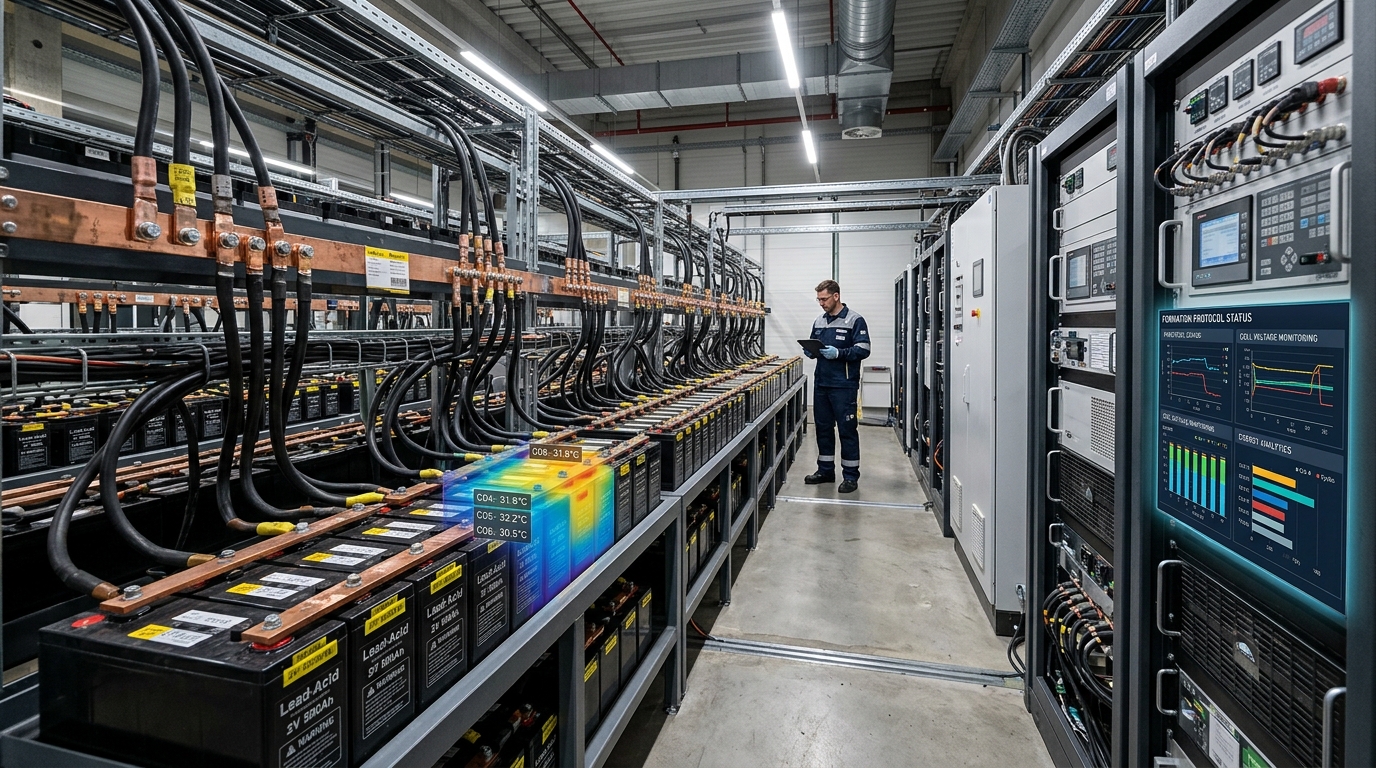
1. Project Overview & Context
A data-driven chemical/process engineering investigation analyzing electricity consumption across 12,286 lead-acid battery formation batches using specific energy metrics, connector resistance, and interruption data to identify energy inefficiencies and theoretical reduction opportunities.
2. Problem Statement
Battery formation—the initial electrochemical charging and curing conversion of unformed paste into active lead dioxide (PbO₂) and spongy lead (Pb)—is the most energy-intensive stage in battery manufacturing, consuming up to 30% of total plant electricity. Energy losses frequently occur due to high electrical connector contact resistance, temperature spikes, circuit load imbalances, and uncoordinated charging interruptions. Plant engineers lack granular analytics linking circuit-level electrical parameters to site energy performance indicators (EnPIs) and ISO 50001 energy baselines.
3. Objectives
1. Analyze a research-grounded synthetic dataset of 12,286 battery formation batches representing 2,126.19 MWh baseline electricity consumption. 2. Calculate Energy Performance Indicators (EnPIs) across formation circuits (mean EnPI: 9.325 kWh per equivalent battery). 3. Identify underperforming circuits using connector resistance, operating temperature, and formation duration data. 4. Quantify theoretical avoidable-energy opportunities and prioritize high-impact maintenance interventions.
4. Simulation Setup & Thermodynamic Selection
Industrial energy data analytics workflow built in Python (Pandas, NumPy, Scikit-learn). Evaluated electrical parameters across multi-circuit formation bays: Specific Electricity Consumption (SEC = kWh / equivalent battery), circuit connector resistance (mΩ), temperature rise (ΔT), and interruption frequency. Regression modeling and outlier clustering identified high-loss circuits.
5. Process Flow & Reduction Chemistry
Industrial energy data analytics workflow built in Python (Pandas, NumPy, Scikit-learn). Evaluated electrical parameters across multi-circuit formation bays: Specific Electricity Consumption (SEC = kWh / equivalent battery), circuit connector resistance (mΩ), temperature rise (ΔT), and interruption frequency. Regression modeling and outlier clustering identified high-loss circuits.
6. Model Input Variables & Boundary Conditions
| Parameter | Value | Units | Engineering Source |
|---|---|---|---|
| Synthetic Demonstration Dataset | 12,286 | formation batches | Industrial Synthetic Benchmark Data |
| Monitored Circuit Population | 134 | active circuits | Multi-Line Formation Floor Baseline |
| Total Baseline Energy Consumption | 2,126.19 | MWh | Aggregated Historical Energy Model |
| Mean Specific Energy (EnPI) | 9.325 | kWh / battery | ISO 50001 Unit Performance Indicator |
| Theoretical Avoidable Energy | 33.06 (1.55%) | MWh | Post-Median Circuit Optimization Target |
7. Multi-Circuit Formation Energy Breakdown & Anomaly Ranking
12,286 Batches across 134 Formation Circuits| Circuit Classification | Batches Run | Total Energy (MWh) | EnPI (kWh/battery) | Optimization Action |
|---|---|---|---|---|
| Circuit 131 (Critical Outlier) | 184 batches | 42.80 MWh | 11.62 kWh/batt (+24.6%) | Priority 1 Shunt & Rectifier Overhaul |
| Circuit 042 (Moderate Anomaly) | 210 batches | 39.10 MWh | 10.15 kWh/batt (+8.8%) | Electrolyte Chilling & Cable Audit |
| Circuit 088 (Standard Operations) | 312 batches | 54.60 MWh | 9.32 kWh/batt (Median) | Standard Preventative Maintenance |
| Circuit 019 (Top Performer) | 290 batches | 47.10 MWh | 8.85 kWh/batt (-5.1%) | Benchmark Reference Profile |
| Total Demonstration Cohort | 12,286 batches | 2,126.19 MWh | 9.325 kWh/batt (Mean) | 33.06 MWh (1.55%) Opportunity |
8. Results & Findings
- 12,286 batches analyzed across 134 operational formation circuits
- Baseline consumption of 2,126.19 MWh mapped with mean EnPI of 9.325 kWh/battery
- Circuit 131 isolated as top outlier at 11.62 kWh/battery (+24.6% specific energy)
- 33.06 MWh (1.55%) theoretical avoidable energy identified across the facility
- Circuit Shunt Health: Eliminates parasitic I²R cabling losses and rectifier drift
- Profile Optimization: Avoids excessive late-stage overcharge heating in formation baths
- ISO 50001 EnPI Tracking: Real-time statistical alarms identify malfunctioning circuits early
- Quality Consistency: Standardized Ah delivery protects battery cycle life and plate conversion
9. Engineering Discussion & Trade-Off Analysis
In battery formation, joule heating from corroded connector busbars and improper clamping torque increases circuit resistance, wasting electricity as heat rather than driving active material electrochemical conversion (PbSO₄ → PbO₂). The analytics framework isolated Circuit 131, where contact resistance averaged 42% above bay mean. Remedying cable terminations and rebalancing formation currents captures the 33.06 MWh theoretical energy opportunity without altering electrochemical recipe parameters.
10. Financial Impact & Decision-Support Platform
Theoretical power avoidance across 12,286 batches via median-aligned current tuning.
Overhauling top outlier circuit eliminates +24.6% localized parasitic energy dissipation.
Establishes ISO 50001 continuous improvement baseline for plant-wide formation audits.
11. Environmental Impact & Decarbonization Value
Optimizing lead-acid battery formation circuits directly curtails industrial Scope 2 electricity demand by a theoretical 33.06 MWh across 12,286 batches, lowering grid carbon intensity and extending equipment reliability.
12. Model Limitations & Scope Boundaries
Evaluated using a research-grounded synthetic dataset for demonstration purposes; real-world industrial deployment requires direct SCADA integration with plant power meters.
13. Engineering Conclusions
Data analytics provides process engineers with actionable visibility into manufacturing electricity consumption. Identifying localized resistance bottlenecks in formation bays establishes an ISO 50001 continuous energy improvement framework.
14. Future Development & Digital Twin Integration
Developing real-time edge-AI anomaly detection for instantaneous formation fault isolation and dynamic thermal-electrochemical finite element coupling.
16. Technical Video Walkthrough
Watch on YouTube Channel (@AndrewOmwengaProcessEng)Need a similar analysis for your process plant?
We build tailored Aspen HYSYS/Plus models and automated Python sensitivity tools to solve real operating penalties.