Is Kenya Ready for Nuclear Power? Uranium Enrichment & Nuclear Fuel Explained
Aspen Plus chemical engineering case study and infrastructure readiness evaluation exploring the nuclear fuel cycle—from natural uranium mining, conversion to UF₆, and gas centrifuge isotope enrichment (U-235/U-238) to ceramic UO₂ fuel pellet fabrication and Kenya's regulatory, grid, and nuclear safety readiness.
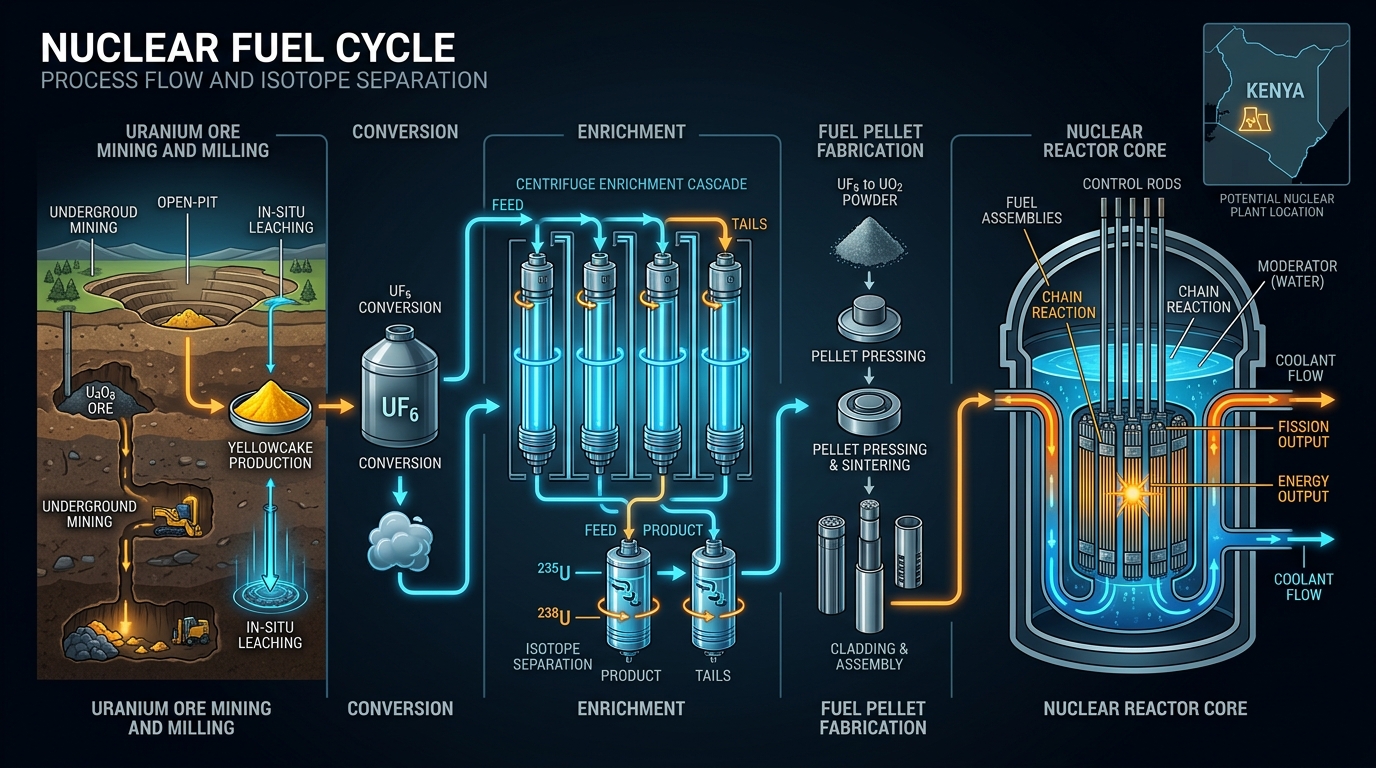
1. Project Overview & Context
Aspen Plus chemical engineering case study and infrastructure readiness evaluation exploring the nuclear fuel cycle—from natural uranium mining, conversion to UF₆, and gas centrifuge isotope enrichment (U-235/U-238) to ceramic UO₂ fuel pellet fabrication and Kenya's regulatory, grid, and nuclear safety readiness.
2. Problem Statement
Could Kenya realistically generate electricity from nuclear power? Kenya's power grid currently relies heavily on geothermal, hydro, and wind, but ambitious industrialization goals require massive, dispatchable, low-carbon baseload energy. While nuclear power offers round-the-clock clean electricity, public and engineering discourse often confuses operating a nuclear power plant with the sensitive chemical processes required to manufacture nuclear fuel. Understanding Kenya's actual nuclear readiness requires decoupling reactor operation from uranium enrichment, analyzing the multi-stage nuclear fuel cycle from a chemical engineering standpoint, and evaluating the institutional, technical, and regulatory prerequisites mandated by the IAEA Milestones Approach.
3. Objectives
1. Map the complete front-end nuclear fuel cycle: uranium mining & milling (U₃O₈ yellowcake), chemical conversion to uranium hexafluoride (UF₆), gas centrifuge isotope separation (U-235 enrichment from 0.71% to 3–5%), and ceramic fuel fabrication (UO₂ pressing and zircaloy cladding). 2. Develop an Aspen Plus flowsheet representation modeling mass and energy balances across conversion (U₃O₈ → UO₂ → UF₄ → UF₆) and centrifuge cascade stage separation factors. 3. Evaluate Kenya's national nuclear infrastructure against the IAEA Milestones Approach: grid carrying capacity (handling 1,000 MWe unit trips), regulatory establishment (KNRA), site selection (coastal vs inland cooling), financing, fuel security treaties, and spent fuel dry-cask storage. 4. Formulate an engineering decision framework for NuPEA (Nuclear Power and Energy Agency) to assess fuel procurement strategies versus domestic supply chain limitations.
4. Simulation Setup & Thermodynamic Selection
Aspen Plus chemical simulation coupled with nuclear fuel cycle material balance algorithms and IAEA infrastructure benchmark metrics. Stage-wise gaseous centrifuge separation modeled utilizing Dirac-Cohen separative work unit (SWU) equations: SWU = P·V(x_p) + W·V(x_w) - F·V(x_f) where V(x) = (2x - 1)ln(x / (1 - x)). The Aspen Plus flowsheet models UF₆ sublimation, gas dynamics, and subsequent defluorination back to UO₂ nuclear-grade powder sintered into ceramic pellets.
5. Process Flow & Reduction Chemistry
The front-end nuclear fuel cycle flowsheet models natural uranium chemical conversion, volatile UF₆ gas handling, counter-current centrifuge isotope cascades, and ceramic nuclear fuel assembly fabrication:
Fluorination converts solid yellowcake into uranium hexafluoride which sublimes into gas at 56.5 °C.
Rotors spinning at >70,000 RPM exploit a 1.26% mass difference across multi-stage cascade feeds.
Enriched gas is defluorinated into UO₂ ceramic pellets sintered at 1700 °C and loaded into zircaloy fuel rods.
6. Model Input Variables & Boundary Conditions
| Parameter | Value | Units | Engineering Source |
|---|---|---|---|
| Reactor Thermal / Electric Power | 3,000 MWth / 1,000 MWe | MW | Commercial Gen-III+ PWR Standard |
| Natural Uranium Feed Assay | 0.711 | wt% U-235 | Natural Isotopic Abundance |
| Enriched Product Fuel Assay | 4.20 | wt% U-235 | Low-Enriched Uranium (LEU) Spec |
| Centrifuge Cascade Tails Assay | 0.22 | wt% U-235 | Economic Optimum Tails Cut |
| Annual Yellowcake Demand | 192.5 | tonnes U₃O₈/yr | 18-Month Refueling Batch Balance |
7. Nuclear Fuel Cycle Mass Balance & Isotope Flowsheet
Annual 1,000 MWe Light Water Reactor Reload| Fuel Cycle Step | Chemical Species | Annual Throughput | U-235 Assay | Physical State |
|---|---|---|---|---|
| 1. Natural Mining & Milling | U₃O₈ (Yellowcake) | 192.5 tonnes / yr | 0.711% (Natural) | Solid Powder |
| 2. Chemical Conversion | UF₆ (Uranium Hexafluoride) | 241.2 tonnes / yr | 0.711% | Sublimed Gas (56.5 °C) |
| 3. Centrifuge Cascade Work | Dirac-Cohen Cascade | 132,400 SWU / yr | Stage Cut = 0.50 | Counter-Current Gas |
| 4. Enriched Fuel Product | Enriched UO₂ Powder | 24.6 tonnes / yr | 4.20% (LEU) | Sintered Ceramic Pellets |
| 5. Depleted Tails Waste | ²³⁸UF₆ (Depleted) | 216.6 tonnes / yr | 0.220% (Tails) | Solid Cylinder Storage |
8. Results & Findings
- Yellowcake Feed: 192.5 tonnes U₃O₈ converted to 241.2 tonnes UF₆ gas/yr
- Cascade Work: 132,400 SWU/yr achieved across stage-wise gas centrifuges
- Product Fuel Yield: 24.6 tonnes/yr of 4.2% enriched UO₂ pellets
- Depleted Tails: 216.6 tonnes/yr depleted uranium at 0.22% U-235
- Clean Energy Potential: 1,000 MWe baseload with zero direct process CO₂
- Grid Stability: Single-unit 1,000 MW trip requires spinning reserves or SMR staging (100–300 MW)
- Enrichment Fallacy: Zero technical need for domestic centrifuges; procurement via IAEA banks
- KNRA Regulatory Framework: Fast-tracking licensing and international safety protocols
- Spent Fuel Management: Establishing interim dry-cask storage and geologic repository roadmaps
9. Engineering Discussion & Trade-Off Analysis
A central chemical engineering takeaway is that uranium enrichment is a purely physical-chemical separation of isotopes with nearly identical chemical properties, relying solely on the 1.26% molecular weight difference between ²³⁵UF₆ and ²³⁸UF₆. For Kenya, investing in domestic enrichment centrifuges would be economically irrational and geopolitically counterproductive. Modern nuclear nations like the UAE, South Korea, and Belgium operate reactors safely while procuring fuel from international consortia. For Kenya, the immediate engineering priority must be grid resilience—upgrading 400 kV and 500 kV transmission lines, expanding spinning reserve capacity, and considering Small Modular Reactors (SMRs) whose 100–300 MW unit sizes align seamlessly with Kenya's grid topology.
10. Financial Impact & Decision-Support Platform
11. Environmental Impact & Decarbonization Value
Nuclear power generation operates with zero direct greenhouse gas emissions during generation. Replacing 1,000 MWe of fossil baseload avoids over 6.5 million metric tons of CO₂ annually while generating constant, dispatchable electricity with the lowest lifecycle land-use footprint of any clean energy source.
12. Model Limitations & Scope Boundaries
Aspen Plus models steady-state UF₆ chemical conversion and idealized stage separation factors; mechanical centrifuge rotor aerodynamics and transient cascade startup dynamics were simplified using analytical SWU correlations.
13. Engineering Conclusions
Is Kenya ready for nuclear power? From a fuel cycle perspective, Kenya does not need its own enrichment facilities—the global commercial fuel market is mature and secure. From an engineering and grid perspective, readiness depends on phased grid reinforcement, human capital development in nuclear reactor engineering, and regulatory maturity. Nuclear energy can serve as a transformative baseload anchor for Kenya's Vision 2030 industrial growth, provided the nation leverages international fuel partnerships and matches reactor capacity to transmission infrastructure.
14. Future Development & Digital Twin Integration
Aspen Plus simulation of nuclear steam supply systems (NSSS) coupled with secondary Rankine cycle cooling towers, and techno-economic screening of Small Modular Reactors (SMRs) vs Large Scale PWRs for the Kenyan grid.
16. Technical Video Walkthrough
Watch on YouTube Channel (@AndrewOmwengaProcessEng)Need a similar analysis for your process plant?
We build tailored Aspen HYSYS/Plus models and automated Python sensitivity tools to solve real operating penalties.