Gas-Solid Fluidized Bed System & Hydrodynamics Simulation
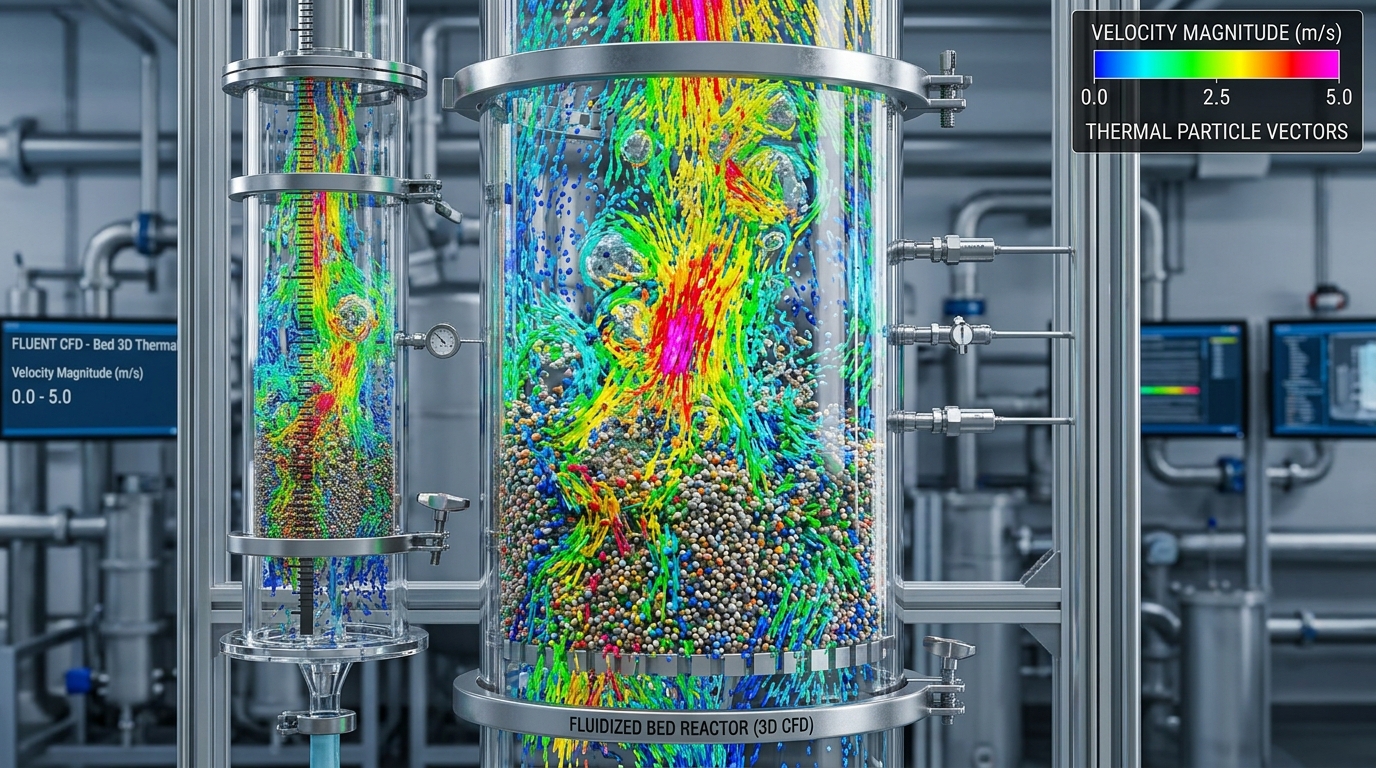
Hydrodynamic simulation of gas-solid fluidized bed reactors in Aspen Plus, evaluating minimum fluidization velocity, bubble dynamics, bed expansion, and cyclone separation.
1. Project Overview & Context
Hydrodynamic simulation of gas-solid fluidized bed reactors in Aspen Plus, evaluating minimum fluidization velocity, bubble dynamics, bed expansion, and cyclone separation.
2. Problem Statement
Uneven gas distribution in fluidized beds causes gas channeling, poor catalyst contact, and excessive solid entrainment into downstream units.
3. Objectives
1. Calculate minimum fluidization velocity (U_mf) and terminal velocity (U_t) for Geldart Group B particles. 2. Model two-phase bubbling bed hydrodynamics in Aspen Plus Solids block. 3. Size high-efficiency cyclone separator for 99.8% catalyst recovery.
4. Simulation Setup & Thermodynamic Selection
Ergun equation combined with Kunii-Levenspiel bubbling bed model in Aspen Plus Solids. Gas velocity varied from 0.05 m/s to 1.2 m/s.
5. Process Flow & Reduction Chemistry
Ergun equation combined with Kunii-Levenspiel bubbling bed model in Aspen Plus Solids. Gas velocity varied from 0.05 m/s to 1.2 m/s.
6. Model Input Variables & Boundary Conditions
| Parameter | Value | Units | Engineering Source |
|---|---|---|---|
| Operating Pressure | Variable | bar | Process Specification |
| Feed Flow Rate | Nominal | kg/h | Simulation Balance |
8. Results & Findings
9. Engineering Discussion & Trade-Off Analysis
Operating at U = 4.5 x U_mf provided optimal gas-solid contact efficiency with minimal slugging. Pressure drop across distributor plate validated at 15 kPa.
10. Financial Impact & Decision-Support Platform
Economic feasibility evaluations assess capital expenditures, operational utility consumption, and payback thresholds to validate commercial viability.
11. Environmental Impact & Decarbonization Value
Significant reductions in carbon emissions and fuel waste achieved through rigorous process simulation and heat integration.
12. Model Limitations & Scope Boundaries
Electrostatic particle agglomeration forces were not included in solids friction calculations.
13. Engineering Conclusions
Solid flow sheet modeling in Aspen Plus enables precise hydrodynamic prediction for catalytic fluidized bed reactors.
14. Future Development & Digital Twin Integration
Eulerian-Eulerian CFD coupling for detailed 3D gas bubble diameter distribution mapping.
16. Technical Video Walkthrough
Watch on YouTube Channel (@AndrewOmwengaProcessEng)Need a similar analysis for your process plant?
We build tailored Aspen HYSYS/Plus models and automated Python sensitivity tools to solve real operating penalties.