Dairy Spray Dryer Exhaust Heat Recovery & CIP Hot Water System
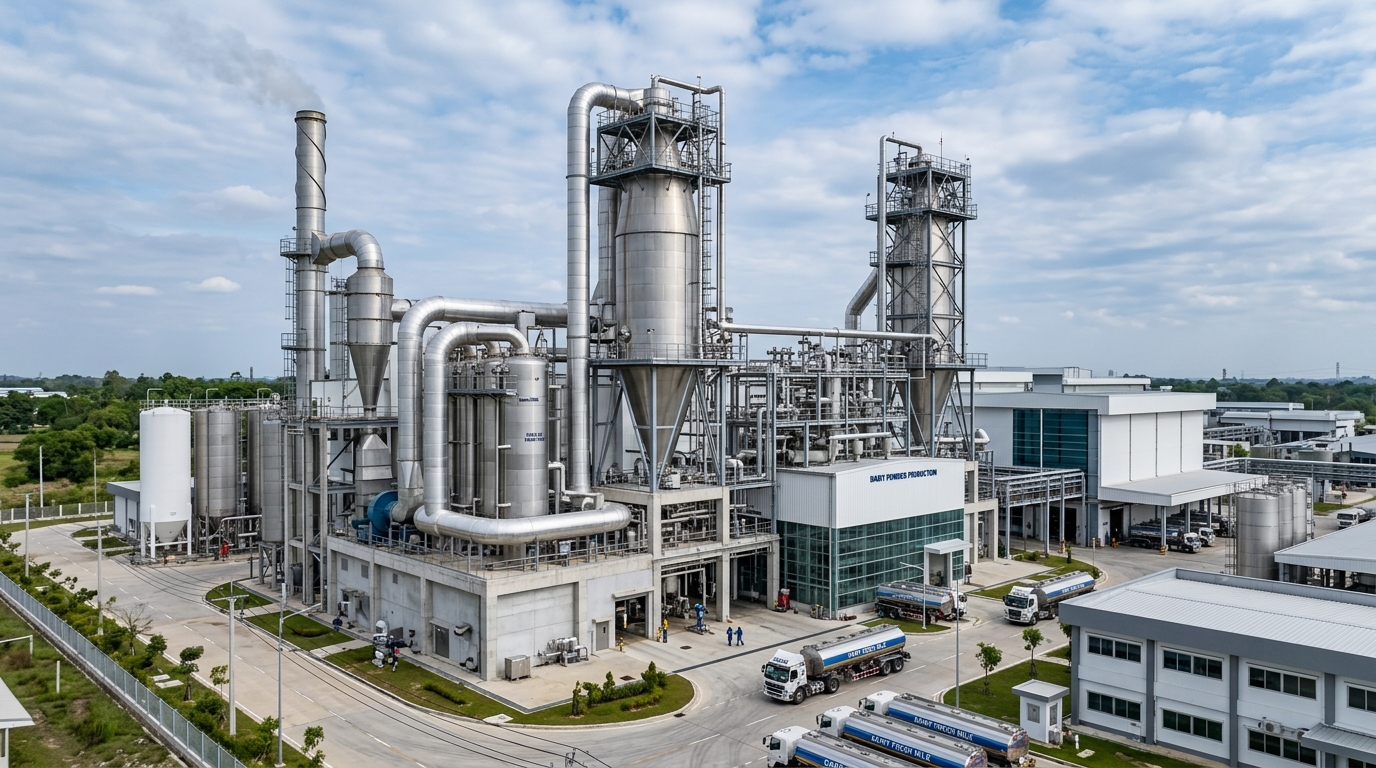
Flue gas and spray dryer exhaust condensing heat recovery system recovering 2.4 MW of low-grade thermal energy to generate continuous 80 °C Clean-In-Place (CIP) washdown and boiler feed preheating for a major dairy processing plant.
1. Project Overview & Context
Flue gas and spray dryer exhaust condensing heat recovery system recovering 2.4 MW of low-grade thermal energy to generate continuous 80 °C Clean-In-Place (CIP) washdown and boiler feed preheating for a major dairy processing plant.
2. Problem Statement
Dairy milk powder spray dryers discharge high volumes of warm, humid exhaust air (85–95 °C) laden with latent moisture and residual powder particulates. At the same time, the facility consumed heavy fuel oil and steam to heat 45 m³/h of fresh water for pasteurization and CIP sanitation loops, wasting over 20% of total site fuel input through boiler and dryer stacks.
3. Objectives
1. Model a direct-contact condensing economizer tower in Aspen Plus to capture both sensible and latent moisture heat from dryer exhaust. 2. Incorporate continuous particulate washdown nozzles to eliminate powder deposition. 3. Integrate heat recovery loop with site thermal storage to supply 80 °C washdown water across fluctuating shift cycles. 4. Quantify natural gas displacement, Scope 1 carbon abatement, and project simple payback.
4. Simulation Setup & Thermodynamic Selection
Rigorous thermodynamic spray scrubber model in Aspen Plus with multi-component water-air psychrometrics. Coupled with Aspen EDR plate heat exchanger sizing to isolate process-contact wash water from exhaust gas condensate.
5. Process Flow & Reduction Chemistry
Rigorous thermodynamic spray scrubber model in Aspen Plus with multi-component water-air psychrometrics. Coupled with Aspen EDR plate heat exchanger sizing to isolate process-contact wash water from exhaust gas condensate.
6. Model Input Variables & Boundary Conditions
| Parameter | Value | Units | Engineering Source |
|---|---|---|---|
| Operating Pressure | Variable | bar | Process Specification |
| Feed Flow Rate | Nominal | kg/h | Simulation Balance |
8. Results & Findings
9. Engineering Discussion & Trade-Off Analysis
By capturing the latent heat of water condensation within the spray dryer exhaust, the condensing heat recovery system dramatically outperforms standard dry economizers. The recovered heat satisfies 100% of the facility's daytime CIP sanitization duty, smoothing boiler firing loads and preventing thermal shock during shift changeovers.
10. Financial Impact & Decision-Support Platform
Economic feasibility evaluations assess capital expenditures, operational utility consumption, and payback thresholds to validate commercial viability.
11. Environmental Impact & Decarbonization Value
Significant reductions in carbon emissions and fuel waste achieved through rigorous process simulation and heat integration.
12. Model Limitations & Scope Boundaries
Requires 316L stainless steel metallurgy to tolerate acidic cleaning agent vapors and moisture condensation.
13. Engineering Conclusions
Condensing exhaust heat recovery delivers rapid financial returns and verified decarbonization for dairy and ingredient manufacturers without compromising sanitary process safety.
14. Future Development & Digital Twin Integration
Integration with Mechanical Vapor Recompression (MVR) for direct evaporator steam regeneration.
16. Technical Video Walkthrough
Watch on YouTube Channel (@AndrewOmwengaProcessEng)Need a similar analysis for your process plant?
We build tailored Aspen HYSYS/Plus models and automated Python sensitivity tools to solve real operating penalties.