Crude Preheat Train Fouling & Furnace Optimization
Quantifying energy penalties, furnace duty increases, and carbon emission surges resulting from severe exchanger fouling in a 100,000 kg/h crude distillation unit (CDU).
1. Project Overview & Context
Quantifying energy penalties, furnace duty increases, and carbon emission surges resulting from severe exchanger fouling in a 100,000 kg/h crude distillation unit (CDU).
2. Problem Statement
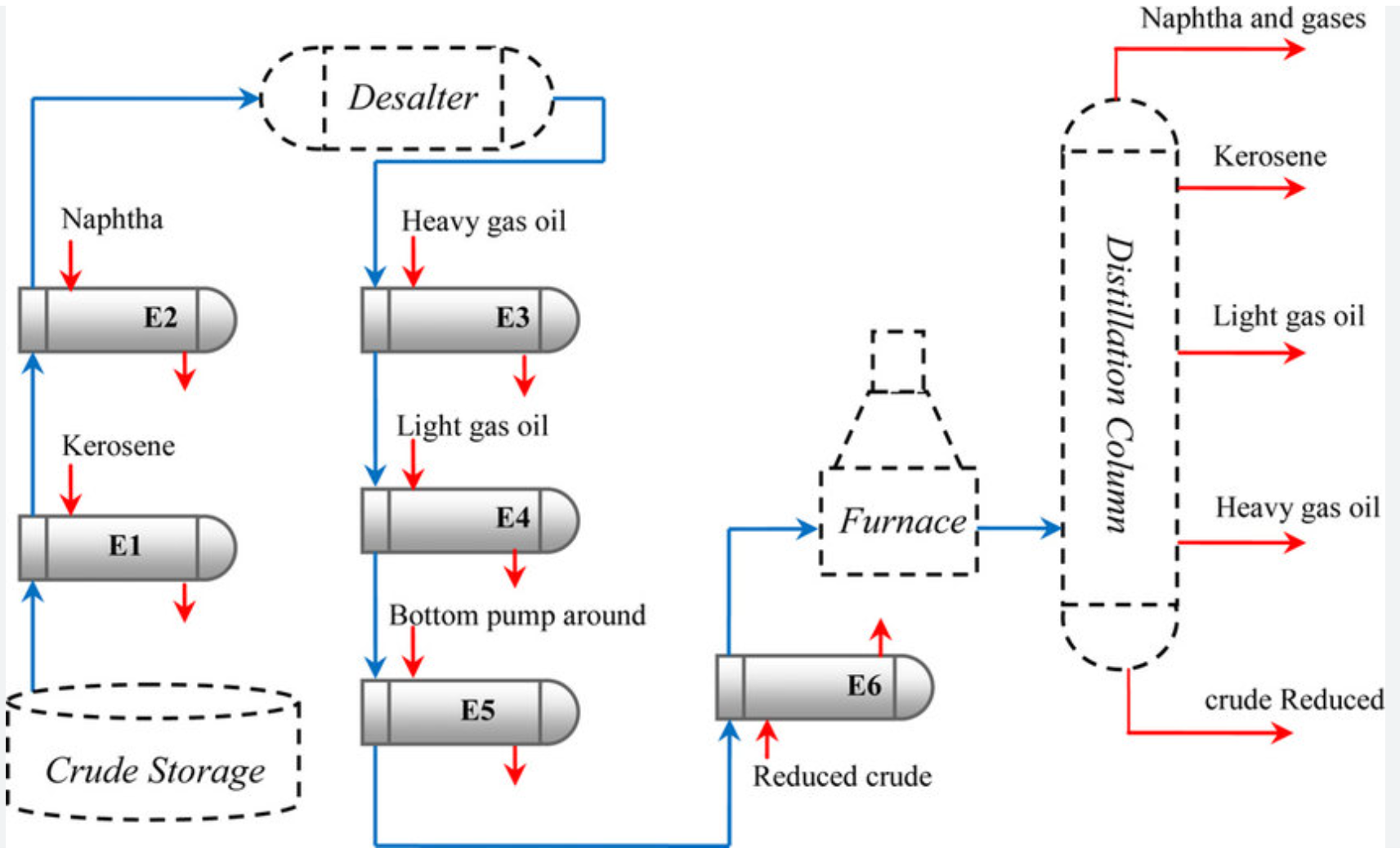
Crude preheat train fouling reduces recovered heat across E-101/102/103 exchangers and forces the fired heater (furnace) to consume additional fuel to maintain the CDU feed temperature at 350 °C.
3. Objectives
1. Model clean baseline preheat train in Aspen HYSYS. 2. Simulate light, moderate, and severe fouling scenarios by adjusting overall heat transfer coefficients (U-values). 3. Calculate resulting furnace duty penalties, fuel cost inflation, and CO2 emission surges. 4. Establish economic cleaning thresholds using Python sensitivity automation.
4. Simulation Setup & Thermodynamic Selection
Rigorous Aspen HYSYS steady-state simulation coupled with Python via Win32 COM API for automated sensitivity analysis. Exchanger performance degraded progressively from clean U=450 W/m²K to U=180 W/m²K under severe fouling.
5. Process Flow & Reduction Chemistry
The preheat train configuration processes a 100,000 kg/h 32° API crude stream through three shell-and-tube exchangers in series prior to entering the fired heater (furnace) and atmospheric crude distillation column (CDU).
6. Model Input Variables & Boundary Conditions
| Parameter | Value | Units | Engineering Source |
|---|---|---|---|
| Crude Mass Flow Rate | 100,000 | kg/h | Refinery Baseline |
| Crude Gravity | 32.0 | °API | Assay Characterization |
| Clean Exchanger U-Value | 450 | W/m²K | Aspen EDR Sizing |
| Fired Heater Target Temp | 350.0 | °C | CDU Flash Spec |
7. Simulated Fouling Severity Scenarios
| Scenario | Furnace Inlet Temp | Furnace Duty (GJ/h) | Duty Increase (%) |
|---|---|---|---|
| CLEAN BASELINE | 220 °C | 47.67 GJ/h | 0.0% (Baseline) |
| LIGHT FOULING | 205 °C | 51.96 GJ/h | +9.0% |
| MODERATE FOULING | 190 °C | 56.15 GJ/h | +17.8% |
| SEVERE FOULING | 170 °C | 61.59 GJ/h | +29.2% Surge |
8. Results & Findings
- Clean Furnace Duty: 47.67 GJ/h
- Severe Fouled Duty: 61.59 GJ/h
- Additional Thermal Duty: +13.92 GJ/h (+29.2%)
- Preheat Exit Temperature Drop: -50 °C
- Furnace Thermal Efficiency = 85.0%
- Natural Gas Fuel Price = $6.00 / GJ
- Annual Operating Hours = 8,000 hours / year
- CO2 Emission Factor = 56.1 kg CO2 / GJ fuel
9. Engineering Discussion & Trade-Off Analysis
The +29.2% duty penalty under severe fouling places significant thermal stress on fired heater tubes, driving up bridge wall temperatures and approaching thermal flux limits. Implementing predictive cleaning automation when furnace inlet temperature drops below 195 °C yields a net annual saving of over $500,000 post-cleaning costs.
10. Financial Impact & Decision-Support Platform
11. Environmental Impact & Decarbonization Value
The 16.38 GJ/h increase in fuel gas consumption releases an additional 918.9 kg CO₂ per hour into the atmosphere, totaling over 7,350 metric tons of extra CO₂ emissions per year under severe fouling.
12. Model Limitations & Scope Boundaries
Model assumes constant crude oil composition (32 API gravity) and steady-state thermal operation without temporal tube skin oxidation dynamics.
13. Engineering Conclusions
Crude preheat train fouling is not merely an operational inconvenience; it is a major energy and environmental liability. Dynamic simulation-based monitoring allows refineries to optimize cleaning cycles before severe fuel penalties accumulate.
14. Future Development & Digital Twin Integration
Integration with Aspen HYSYS Dynamics to capture transient thermal inertia during furnace firing rate ramping.
16. Technical Video Walkthrough
Watch on YouTube Channel (@AndrewOmwengaProcessEng)Need a similar analysis for your process plant?
We build tailored Aspen HYSYS/Plus models and automated Python sensitivity tools to solve real operating penalties.