Multinational Brewery Flue Gas Condensing Economizer System
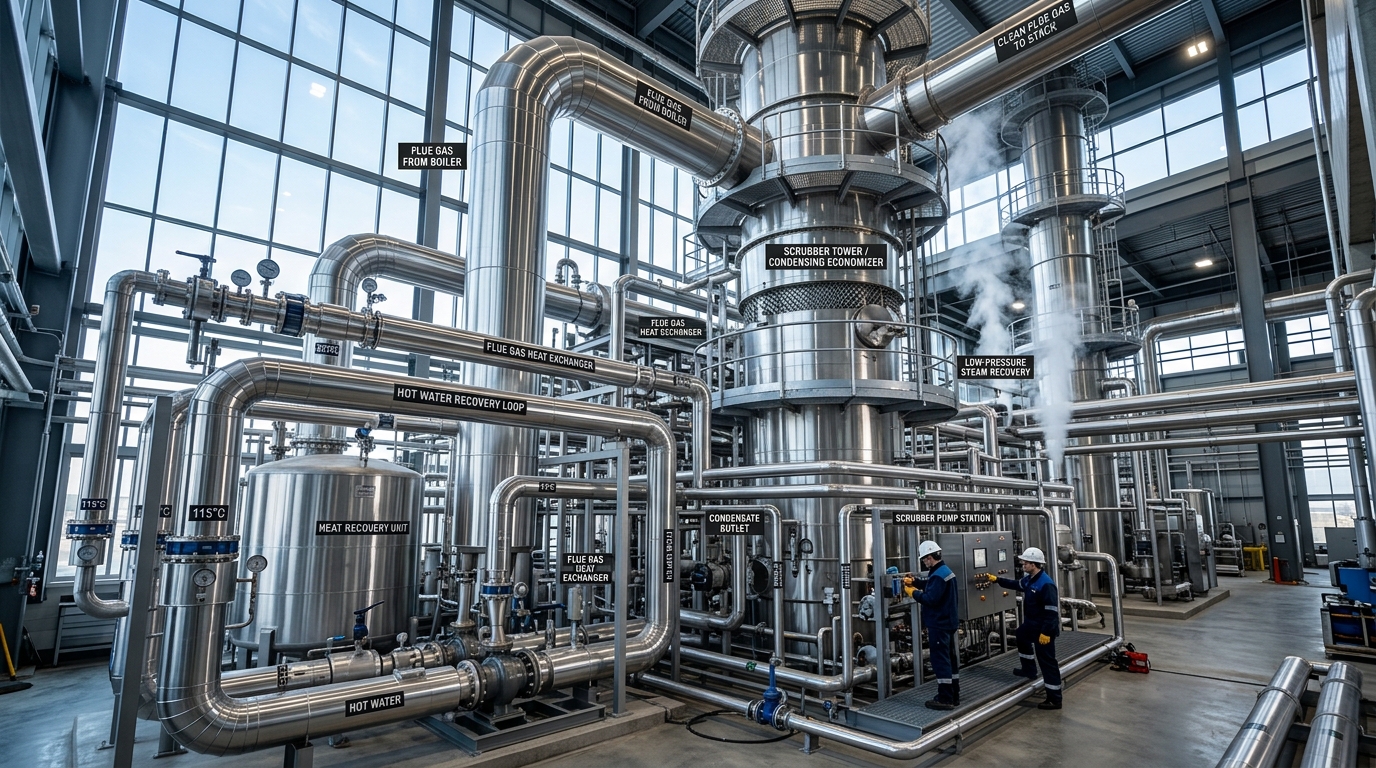
Industrial boiler flue gas condensing heat recovery system installed on three 15 t/h steam boilers at a commercial brewing facility, capturing waste heat and saving 8 million liters of water annually while cutting natural gas consumption by 16%.
1. Project Overview & Context
Industrial boiler flue gas condensing heat recovery system installed on three 15 t/h steam boilers at a commercial brewing facility, capturing waste heat and saving 8 million liters of water annually while cutting natural gas consumption by 16%.
2. Problem Statement
Brewing operations require intensive steam for wort boiling, mash tun heating, pasteurizing, and bottle washing. The facility's steam boilers discharged flue gas at 195 °C directly to atmosphere, resulting in severe sensible and latent heat loss while drawing substantial freshwater for boiler make-up and pasteurization.
3. Objectives
1. Model boiler combustion flue gas condensation in Aspen HYSYS. 2. Size a two-stage direct-contact condensing economizer and indirect plate heat recovery train in Aspen EDR. 3. Reclaim condensed water vapor to offset site water utility costs. 4. Achieve simple payback under 3.5 years with guaranteed CO2 abatement.
4. Simulation Setup & Thermodynamic Selection
Thermodynamic combustion and condensation modeling in Aspen HYSYS. Flue gas cooled from 195 °C to 38 °C, extracting both sensible heat and latent heat of moisture condensation into incoming process water loops.
5. Process Flow & Reduction Chemistry
Thermodynamic combustion and condensation modeling in Aspen HYSYS. Flue gas cooled from 195 °C to 38 °C, extracting both sensible heat and latent heat of moisture condensation into incoming process water loops.
6. Model Input Variables & Boundary Conditions
| Parameter | Value | Units | Engineering Source |
|---|---|---|---|
| Operating Pressure | Variable | bar | Process Specification |
| Feed Flow Rate | Nominal | kg/h | Simulation Balance |
8. Results & Findings
9. Engineering Discussion & Trade-Off Analysis
The two-stage condensing system preheats boiler feed water to 85 °C and pasteurization water to 68 °C simultaneously. The reclaimed condensate is neutralized and recycled for utility cooling tower make-up, delivering significant dual-utility (gas + water) savings.
10. Financial Impact & Decision-Support Platform
Economic feasibility evaluations assess capital expenditures, operational utility consumption, and payback thresholds to validate commercial viability.
11. Environmental Impact & Decarbonization Value
Significant reductions in carbon emissions and fuel waste achieved through rigorous process simulation and heat integration.
12. Model Limitations & Scope Boundaries
Flue gas acid dew point requires duplex stainless steel materials for corrosion prevention.
13. Engineering Conclusions
Condensing economizers deliver deep decarbonization and water resilience for modern breweries, converting chimney waste into high-grade process heat.
14. Future Development & Digital Twin Integration
Integration with CO2 recovery liquefaction chillers.
16. Technical Video Walkthrough
Watch on YouTube Channel (@AndrewOmwengaProcessEng)Full Video Tutorial Available on YouTube
Watch Eng. Andrew Omwenga demonstrate the complete process simulation step-by-step.
Watch Tutorial VideoNeed a similar analysis for your process plant?
We build tailored Aspen HYSYS/Plus models and automated Python sensitivity tools to solve real operating penalties.