Steam Boiler Energy Predictive Maintenance & Efficiency Model
Industrial predictive maintenance and thermal efficiency model developed for Proton Bakers, Zimbabwe, analyzing boiler stack losses, excess O2, and tube scaling.
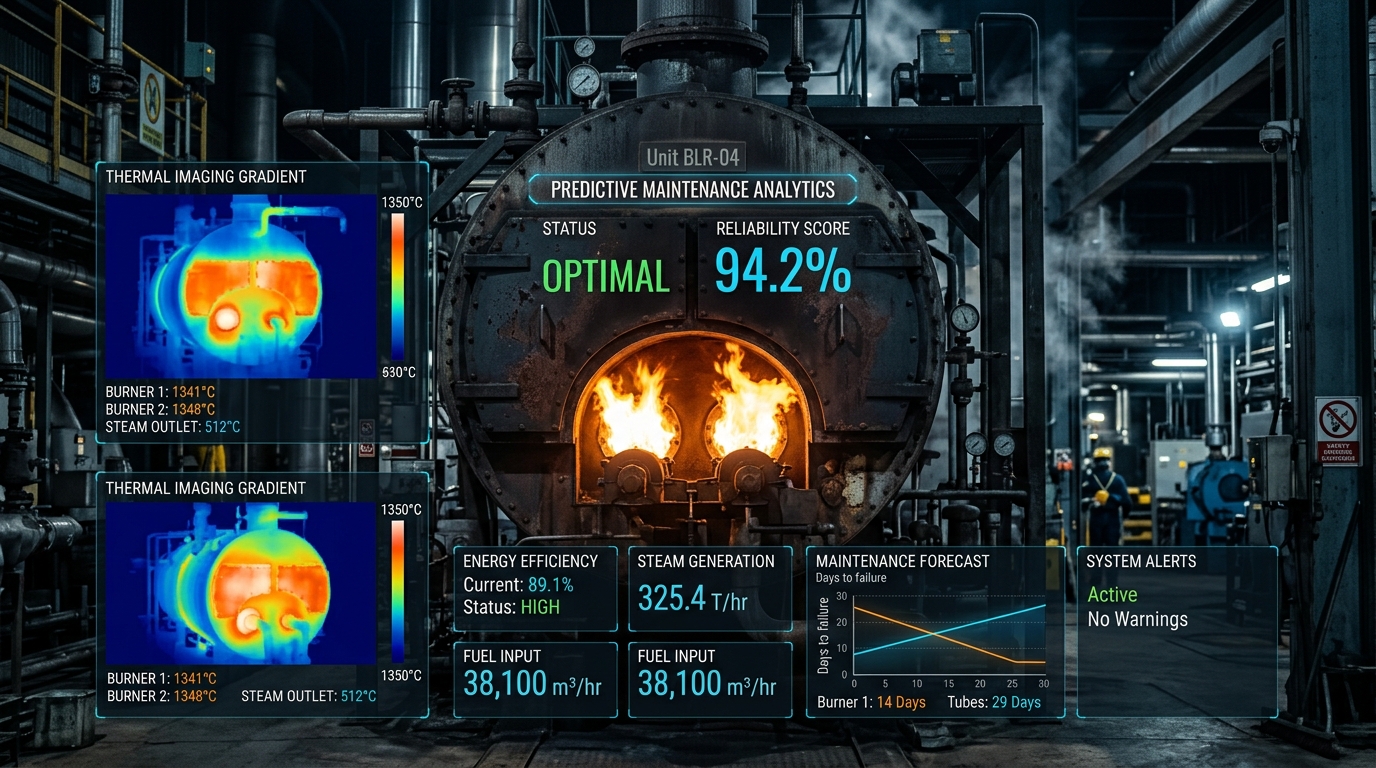
1. Project Overview & Context
Industrial predictive maintenance and thermal efficiency model developed for Proton Bakers, Zimbabwe, analyzing boiler stack losses, excess O2, and tube scaling.
2. Problem Statement
Unscheduled boiler shutdowns caused by thermal stress and water-side tube scaling inflated emergency maintenance costs and disrupted bakery production schedules.
3. Objectives
1. Build real-time thermodynamic boiler model in Aspen HYSYS linked with Python automated data logger. 2. Monitor flue gas temperature and excess oxygen to optimize air-fuel ratio. 3. Predict optimal sootblowing and blowdown intervals to avoid thermal shutdowns.
4. Simulation Setup & Thermodynamic Selection
Python Win32 COM API connecting Aspen HYSYS boiler simulation with plant sensor data streams. Calculated direct and indirect boiler thermal efficiency according to ASME PTC 4.
5. Process Flow & Reduction Chemistry
Python Win32 COM API connecting Aspen HYSYS boiler simulation with plant sensor data streams. Calculated direct and indirect boiler thermal efficiency according to ASME PTC 4.
6. Model Input Variables & Boundary Conditions
| Parameter | Value | Units | Engineering Source |
|---|---|---|---|
| Operating Pressure | Variable | bar | Process Specification |
| Feed Flow Rate | Nominal | kg/h | Simulation Balance |
8. Results & Findings
9. Engineering Discussion & Trade-Off Analysis
Maintaining excess flue gas O2 at 3.2% (vs 5.8% previously) reduced stack heat losses by 4.2%, while automated blowdown control prevented silica scale accumulation.
10. Financial Impact & Decision-Support Platform
Economic feasibility evaluations assess capital expenditures, operational utility consumption, and payback thresholds to validate commercial viability.
11. Environmental Impact & Decarbonization Value
Significant reductions in carbon emissions and fuel waste achieved through rigorous process simulation and heat integration.
12. Model Limitations & Scope Boundaries
Sensor signal noise required moving average smoothing filters before feeding thermodynamic calculations.
13. Engineering Conclusions
Python-automated Aspen HYSYS models provide continuous predictive diagnostic power for industrial steam assets.
14. Future Development & Digital Twin Integration
Machine learning neural network integration for real-time burner combustion tuning.
16. Technical Video Walkthrough
Watch on YouTube Channel (@AndrewOmwengaProcessEng)Full Video Tutorial Available on YouTube
Watch Eng. Andrew Omwenga demonstrate the complete process simulation step-by-step.
Watch Tutorial VideoNeed a similar analysis for your process plant?
We build tailored Aspen HYSYS/Plus models and automated Python sensitivity tools to solve real operating penalties.