Heat Exchanger Design & Rating (Aspen EDR)
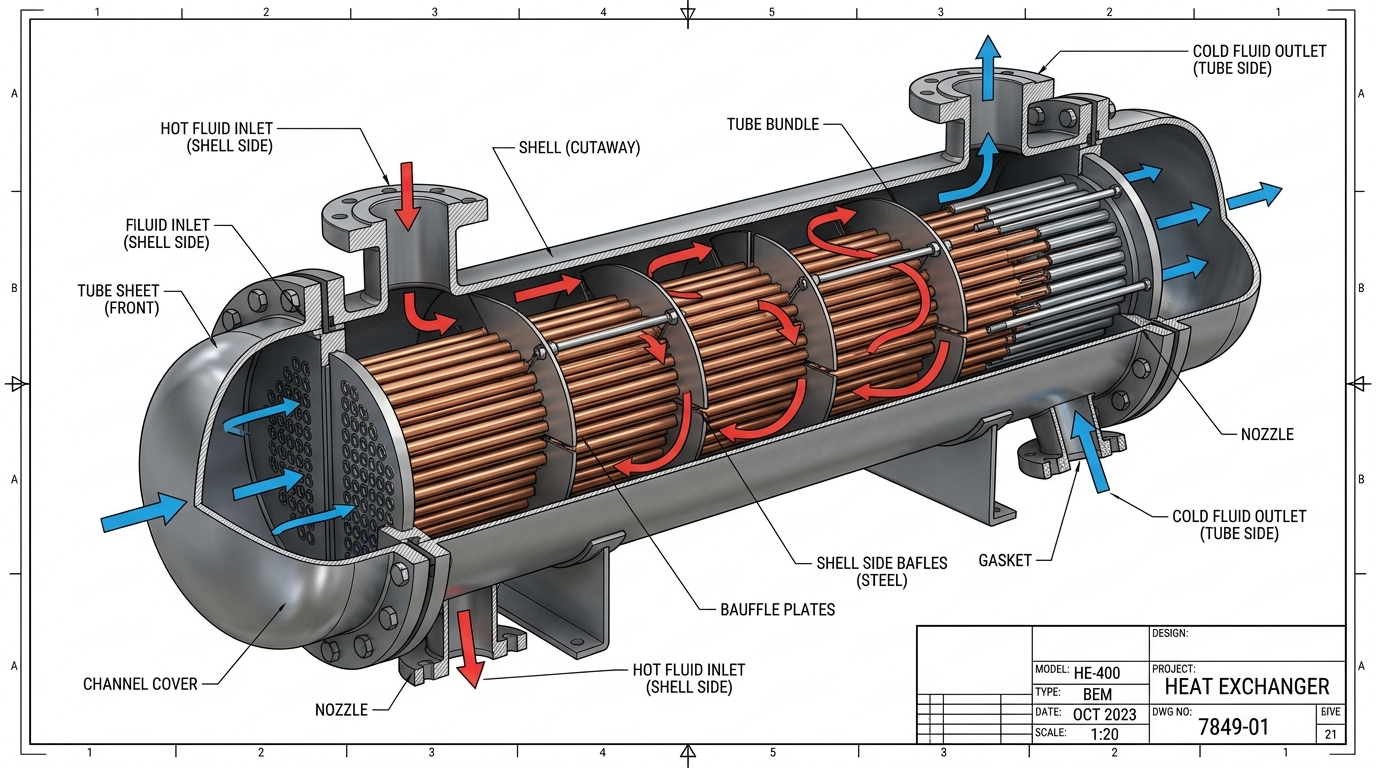
Rigorous thermal & mechanical design rating of TEMA E-type shell-and-tube heat exchangers in Aspen EDR, optimizing baffle cut, tube layout, acoustic vibration, and pressure drop.
1. Project Overview & Context
Rigorous thermal & mechanical design rating of TEMA E-type shell-and-tube heat exchangers in Aspen EDR, optimizing baffle cut, tube layout, acoustic vibration, and pressure drop.
2. Problem Statement
Sub-optimal exchanger sizing in chemical process plants leads to excessive tube-side pressure drops, shell-side flow maldistribution, and destructive acoustic resonance vibration.
3. Objectives
1. Perform thermal rating and geometry optimization using Aspen Exchanger Design & Rating (EDR). 2. Optimize baffle pitch (25% to 45% cut) to maximize overall heat transfer coefficient (U) while staying within pressure drop allowances. 3. Verify acoustic resonance and tube fluid-elastic instability margins.
4. Simulation Setup & Thermodynamic Selection
Integrated Aspen EDR sizing linked directly to Aspen HYSYS flowsheet stream data. Evaluated 19.05 mm OD BWG 16 stainless steel tubes on a 23.81 mm triangular pitch.
5. Process Flow & Reduction Chemistry
Integrated Aspen EDR sizing linked directly to Aspen HYSYS flowsheet stream data. Evaluated 19.05 mm OD BWG 16 stainless steel tubes on a 23.81 mm triangular pitch.
6. Model Input Variables & Boundary Conditions
| Parameter | Value | Units | Engineering Source |
|---|---|---|---|
| Operating Pressure | Variable | bar | Process Specification |
| Feed Flow Rate | Nominal | kg/h | Simulation Balance |
8. Results & Findings
9. Engineering Discussion & Trade-Off Analysis
Increasing baffle spacing from 200 mm to 320 mm with a 30% single-segmental baffle cut eliminated flow-induced tube vibration without sacrificing thermal performance.
10. Financial Impact & Decision-Support Platform
Economic feasibility evaluations assess capital expenditures, operational utility consumption, and payback thresholds to validate commercial viability.
11. Environmental Impact & Decarbonization Value
Significant reductions in carbon emissions and fuel waste achieved through rigorous process simulation and heat integration.
12. Model Limitations & Scope Boundaries
Calculations based on clean fluid heat transfer correlation; long-term biological fouling rates omitted.
13. Engineering Conclusions
Coupling Aspen EDR with HYSYS flowsheets guarantees mechanical integrity and optimal heat transfer efficiency prior to fabrication.
14. Future Development & Digital Twin Integration
Plate-and-frame exchanger rating comparison for high NTU low-approach temperature duties.
16. Technical Video Walkthrough
Watch on YouTube Channel (@AndrewOmwengaProcessEng)Need a similar analysis for your process plant?
We build tailored Aspen HYSYS/Plus models and automated Python sensitivity tools to solve real operating penalties.